The Math of Gambling: House Edge, Variance, and Expected Value
Picture this: a quiet buzz, cards flip, chips click. A friend hits a small win, then a big one. You feel the rush. Was it skill? Was it luck? Or was it…
On this page (11 sections)
- A 60-Second Gut Check (Quick Quiz)
- House Edge: What the Casino Wins on Average
- Expected Value (EV): The Long‑Run Compass
- Variance and Standard Deviation: Why Your Night Feels “Unfair”
- A Reality Check Table (Data You Can Use)
- Lab: From Rules to Edge (Worked Examples)
- Myths vs Math
- If You Still Play: Bankroll, Volatility, and Limits
- Checking Game Fairness and Claimed RTPs
- FAQ
- Sources, Methods, and What to Try Next
Picture this: a quiet buzz, cards flip, chips click. A friend hits a small win, then a big one. You feel the rush. Was it skill? Was it luck? Or was it math at work the whole time? This guide shows the math in plain words so you can see what is really going on when you bet.
A 60-Second Gut Check (Quick Quiz)
- In single-zero roulette, a straight-up win pays 35:1. What would a “fair” payout be if there were 37 slots? (Hint: think 36:1.)
- Which eats a bankroll faster for many small bets: a high‑volatility slot with 96% RTP, or European roulette at 97.3% RTP? (Assume the same pace and stake.)
- Does changing your bet size change the house edge on that game?
- How many bets does it take before results start to look like the long‑run average? (10? 100? 10,000?)
Quick answers: (1) 36:1 would be fair; 35:1 makes the house edge. (2) Often the slot, because of pace and swings. (3) No; bet size does not change edge. (4) A lot more than most people think.
House Edge: What the Casino Wins on Average
House edge is the built‑in cut the casino expects to keep from each bet over time. If a game has a 2% house edge, the long‑run loss is 2 cents per dollar bet. The flip side is RTP (return to player). RTP = 1 − house edge. Regulators define how RTP should be set and tested. See the industry explanation of return to player (RTP) in the UK rules here: industry explanation of return to player (RTP).
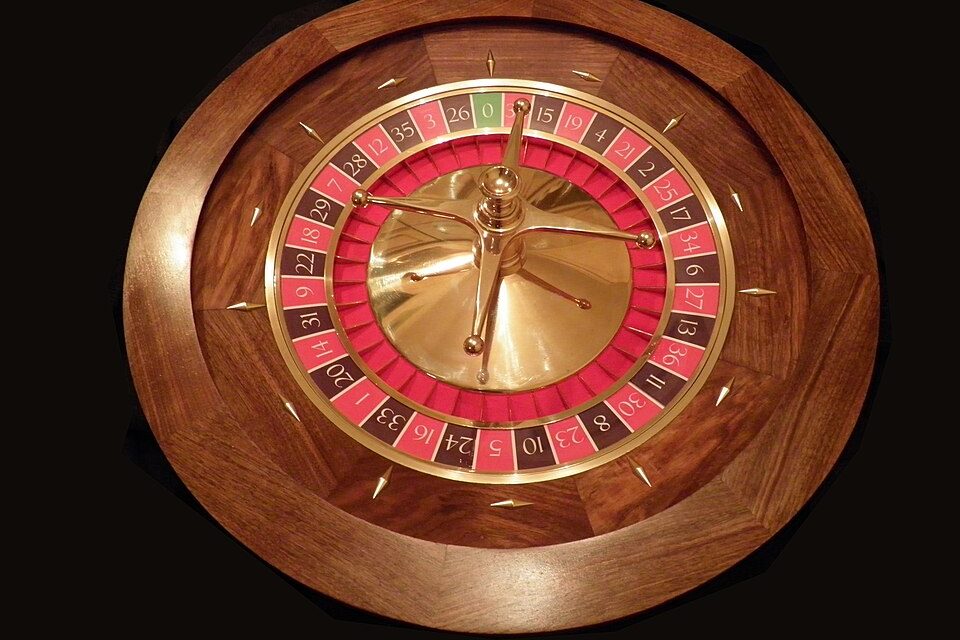
Why does a casino have an edge at all? Payouts are a bit lower than the true odds of a win. For example, in single-zero roulette there are 37 slots, yet a straight-up pays 35:1, not 36:1. That gap is the house edge. You can read more about how casino games are designed to have a house advantage from the American Gaming Association: how casino games are designed to have a house advantage.
Per bet vs per hour matters. If your game has a 2% edge against you and you bet $10, your expected loss is $0.20 per bet. If you make 300 bets in an hour, that is $60 in expected loss. Pace is part of the math.
Expected Value (EV): The Long‑Run Compass
Expected value is the average result you would get if you could repeat a bet many times. Positive EV means profit in the long run. Negative EV means loss in the long run. The formal idea comes from probability theory; a clear entry is here: expected value in probability, and a gentle intro is here: expected value basics.
Simple example: a $2 lottery ticket pays $1,000,000 with a chance of 1 in 10,000,000, and $0 otherwise. EV ≈ (1/10,000,000 × $1,000,000) − $2 = $0.10 − $2 = −$1.90. In casino play, a Banker bet in baccarat has a house edge near 1.06%. If you bet $10, the EV per bet is −$0.106. EV guides you, but it does not tell you what happens tonight. The short run can swing.
Variance and Standard Deviation: Why Your Night Feels “Unfair”
Variance measures how spread out results are around the average. Standard deviation is the square root of variance; it is in the same units as your wins and losses. High variance means long dry spells and rare big hits. Low variance means many small wins and losses. Precise terms live here: variance and standard deviation, definitions.
Think of two games with the same 4% edge against you. Game A pays small wins often. Game B pays a big win now and then. The edge is the same, but the ride is not. In Game B, you can feel “up” or “down” a lot. That is variance at work. Your bet size and the number of bets also push variance around. Double your stake, and your swings double. Make more bets per hour, and you see more of the distribution in the same time.
Over 100 bets, you can be far from EV. Over 1,000 bets, results tend to move closer. Over 10,000 bets, they are closer still. Yet even then, luck can still show up. The key is to know the spread is normal, not a sign that a table is “hot” or “cold.”
Micro‑aside: The Law of Large Numbers
The law of large numbers says sample averages move toward the true average as the number of trials grows. It does not promise quick “catch up.” Ten spins is noisy. 100 is better. 10,000 is steadier. A short read: Law of Large Numbers explained.
A Reality Check Table (Data You Can Use)
Use this table to estimate what a game may cost per hour. Numbers are typical, not exact. Rules and speed vary by venue and maker. Expected loss per hour = Stake × Bets per hour × House edge.
| Blackjack (3:2, basic strategy) | ~0.5% | Low–Medium | 70 | $10 | $3.50 | Edge rises if you deviate from basic strategy |
| Blackjack (6:5 payout) | ~2.0% | Low–Medium | 70 | $10 | $14.00 | 6:5 cuts the blackjack win; sharp jump in edge |
| Roulette (single‑zero) | 2.70% | Low | 40 | $10 | $10.80 | All even‑money bets share the same edge |
| Roulette (double‑zero) | 5.26% | Low | 40 | $10 | $21.04 | Extra zero doubles the pain |
| Baccarat (Banker) | ~1.06% | Low | 60 | $10 | $6.36 | Includes commission on Banker wins |
| Baccarat (Player) | ~1.24% | Low | 60 | $10 | $7.44 | Player has a bit more edge against you |
| Baccarat (Tie at 8:1) | ~14.36% | High | 60 | $10 | $86.16 | Some tables pay 9:1; still a bad bet |
| Craps (Pass Line) | ~1.41% | Low | 45 | $10 | $6.35 | Odds bets have 0% edge but need a point |
| Craps (Any 7) | 16.67% | High | 45 | $10 | $75.02 | Fast way to burn a stake |
| Video Poker (Jacks or Better 9/6, perfect play) | ~0.46% | Low–Medium | 400 | $1.25 | $2.30 | Only with perfect strategy; paytables vary |
| Slots (RTP ~96%, high volatility) | 4% | High | 500 | $1.00 | $20.00 | Online pace can be far higher; stakes vary |
How to read this: if you raise your stake, losses scale. If you slow down, cost per hour drops. Rules matter a lot. The same game can change from “gentle” to “rough” with one rule tweak.
Lab: From Rules to Edge (Worked Examples)
Let’s do two short builds so you can see where numbers come from. If you want full course notes, try MIT OpenCourseWare: introductory probability course notes.
a) Blackjack 3:2 vs 6:5
In 3:2 games, a natural blackjack pays 1.5× your bet. In 6:5, it pays 1.2×. That one change removes value from one of your best outcomes. For a typical shoe game, the house edge jumps by about 1.4 percentage points when you move from 3:2 to 6:5. With a $10 stake and 70 hands per hour, that is the difference between about $3.50 lost per hour (0.5%) and about $14 lost per hour (2.0%). Same speed. Same player. Rule change does the work.
b) Single‑zero vs double‑zero roulette
On an even‑money bet in European roulette, EV per $10 bet is −2.70% × $10 = −$0.27. In American roulette, EV per $10 bet is −5.26% × $10 = −$0.53. At 40 spins per hour, your hourly EV is about −$10.80 vs −$21.04. One extra zero doubles the long‑run drain.
Formula note: EV = sum over outcomes of (probability × payoff) minus your stake. In regulated markets, device rules and tests are set by standards. For slot devices, see Nevada’s gaming device technical standards.
Myths vs Math
- Myth: “Tables get hot.” Fact: Results cluster by chance. The edge does not change because of a streak.
- Myth: “A bet system (like Martingale) beats the house.” Fact: Systems change variance, not edge. Risk of ruin rises fast with table limits.
- Myth: “Slots are due.” Fact: Modern slots use RNGs. Past spins do not affect the next spin.
- Myth: “Big bets win more.” Fact: Bet size scales wins and losses. The edge stays the same.
If you enjoy theory links, here is a broad view on choices under risk: overview of decision theory and risk.
If You Still Play: Bankroll, Volatility, and Limits
Decide the cost of your fun before you play. Set a hard loss limit and a time limit. Do not chase. Lower pace and lower edge mean longer play for the same budget. If you like swings, know that “high variance” means bigger downswings too. Keep your unit size small. A simple guide: bet 1% or less of your session bankroll per hand on low‑edge games. For high‑variance slots, even less.
Some players read about the Kelly criterion. It is a growth idea from markets; it is not a magic fix, and it assumes a positive edge. History and math background here: the Kelly criterion background.
Always check rules and stated RTP before you sit down, online or on the floor. We run independent checks on rules and payouts in our write‑ups, with each brand clearly tagged and rated by CasinosClub.at. Note: we never promise profits; math says the house has the edge.
Checking Game Fairness and Claimed RTPs
Know the rules and who checks the tech. For online games in many markets, makers and casinos must follow technical standards and audits (see the UK RTP link above, and Nevada’s device rules in the Lab section). If you want high‑level data and research on games and rules, see the UNLV Center for Gaming Research.
If gambling stops being fun, get help right away. Here are responsible gambling resources you can use. You are not alone.
FAQ
Is a 96% RTP slot “good”?
It is common. But RTP is a long‑run number. The ride may still be rough if the game has high variance. Check pace and stake too.
How many bets until EV “shows up”?
There is no hard line. A few dozen bets is noise. A few hundred starts to smooth. A few thousand gives a clearer view. Even then, swings happen.
Does bet size change the house edge?
No. It scales your wins and losses but does not change the edge. Rules and pay tables do.
Can skill beat the house?
In a few games, skill can cut the edge (e.g., blackjack with perfect play). But with normal rules, the house still holds a small edge. Only rare spots, like promotions or errors, can flip EV. Most play is negative EV.
What is a fair roulette payout?
For a straight‑up bet with 37 slots, a fair payout is 36:1. The real payout is 35:1. That gap funds the house edge.
Which games run fastest?
Slots and video poker can be very fast, hundreds of bets per hour. Fast pace plus any edge against you means higher expected loss per hour.
Sources, Methods, and What to Try Next
Method notes: House edge and RTP are two sides of the same coin. Table numbers here use common rule sets and simple pace estimates from typical floors and lobbies. Expected loss per hour uses Stake × Bets per hour × Edge. Some games, like slots and video poker, vary by maker and pay table. Always check local rules and posted info. For formal terms, see the links to NIST (variance), MathWorld and Khan Academy (EV), Britannica (LLN), and the standards pages (UK and Nevada). For a wider learning path, try the MIT OpenCourseWare page on probability listed above.
Try this next: rebuild the table for your own stake and speed. Change one rule (say, blackjack 3:2 to 6:5) and see how your hourly cost moves. The math is simple. The impact is not.
18+ only. Gambling can become harmful; free, confidential help is available 24/7 from the National Responsible Gambling Programme on 0800 006 008. This page is general information, not legal or financial advice.